Episode Transcript
KB [00:00:10]:
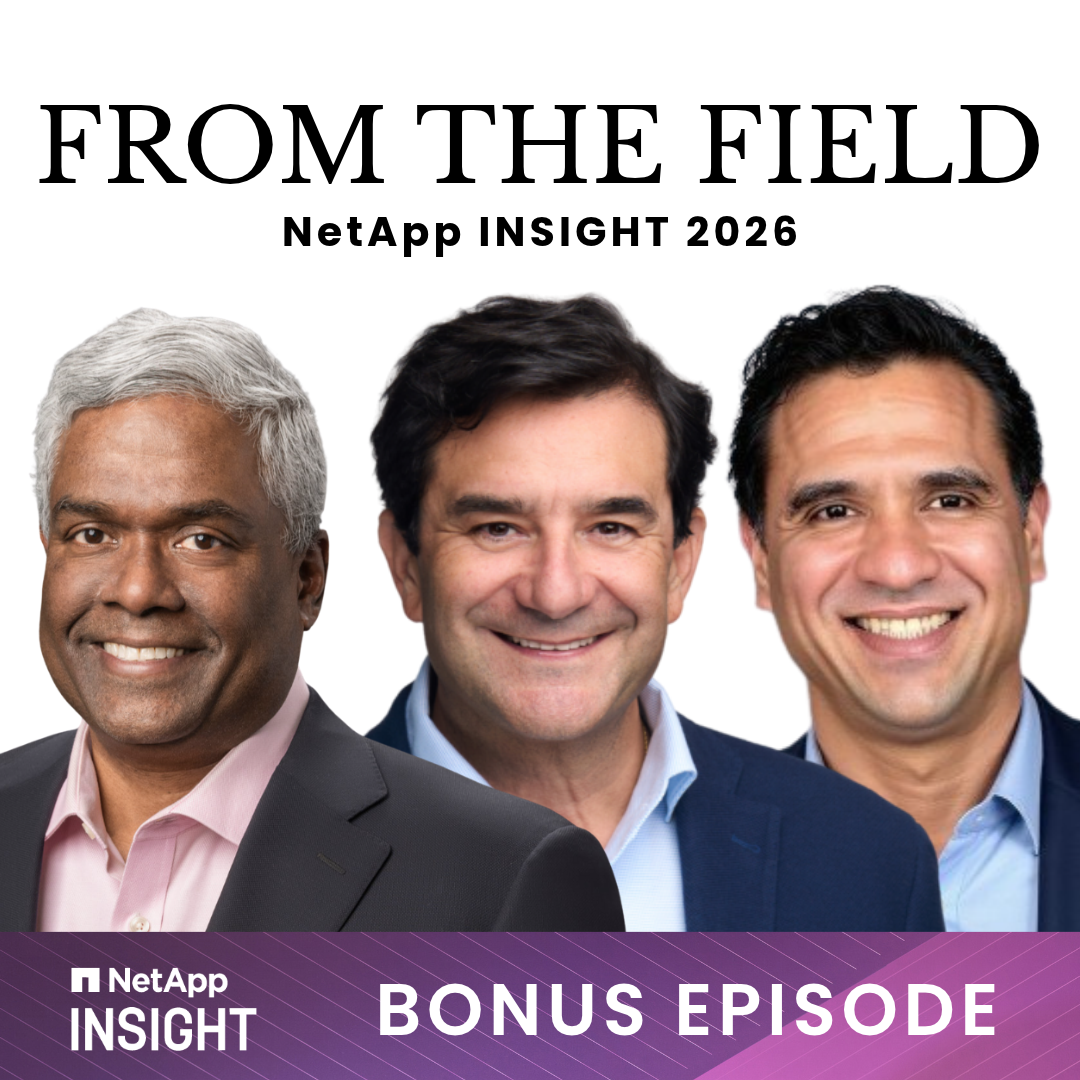
What's up everyone? It's KB coming to you from MGM Grand here in Las Vegas for NetApp Insight. Every technology company has an AI strategy and executives are talking about transformation. What actually has to change inside a business to make any of this work? Because buying infrastructure is one thing. Connecting the technology, the people, and the partners need to turn that investment into results is a whole new game. For this episode, I'm bringing together 3 conversations with George Kurian, Chief Executive Officer, César Cernuda, President, and Álvaro Celis, Chief Partner and Ecosystem Officer, who all work at NetApp to explore that challenge from the top. We're looking at how the direction set by leadership connects with execution across customers and partners, where the ambition meets the reality, and what it takes to move an entire organization forward. When the pressure is on to move faster, who makes sure everyone is moving towards the same outcome? This is KB from the field at NetApp Insight 2026.
KB [00:01:24]:
Let's get into it. Joining me now is George Kurian, CEO of NetApp, and today we're discussing NetApp's evolution from a storage company into a comprehensive platform and solutions provider and the strategic bets behind that transformation. So George, thanks for joining me and welcome.
George Kurian [00:01:44]:
Thank you.
KB [00:01:45]:
So before we get into that, Given your role as Chief Executive Officer of a global company, I wanna start with hearing your perspective on the current landscape, the opportunities, and the challenges.
George Kurian [00:02:00]:
We are at a really important moment in the evolution of our industry and the business world at large. We have more powerful tools than ever before, AI tools that allow businesses to extract the full value of all of the data within their business to make their businesses a lot more successful and to make those capabilities available to all of their employees, right? Historically, you could access roughly 15% of the data through traditional applications, and you would make it available to roughly 15% of the organization. Now you can go after all of it. And make it available to everybody because you've got natural language or conversational interfaces to all of that intelligence. I think the challenges are, you know, there's a couple of them, right? I think one is these tools require the data to be curated well, and that's a hard task, and we are working on solutions to that task. And then the second is, these tools are enormously powerful. And so you need people to have responsibility and have a sense of values around what they offer to clients so that clients can trust them.
KB [00:03:21]:
And so George, would you say that, I mean, you said before 15%, now people are really going after it. Do you think that's sort of what's happening now at the market? Do you think it's quite an, maybe an aggressive approach for people to really extract the full value and benefit of what they can get?
George Kurian [00:03:36]:
I think the market's transitioned, you know, in 2 steps, right, already. The first step was to get the algorithms, meaning the models, sophisticated. And I think perhaps at the early days of AI, people thought that the models could figure everything out for themselves. They didn't need context, which is the enterprise's data. The second step was they took those modern applications and applied it to their already organized data, right? So they took the 15% that was well organized and they said, now find me even more insight out of the 15. They are now beginning to work on the remaining 85, which has all the real texture of the organization, the sentiment and the, you know, sort of the emails between clients and, you know, sort of parts of your organization and so on. And I think that's where we see the challenges. 93% of organizations have had 2 fundamental problems.
George Kurian [00:04:37]:
One is to harness the value of their data by organizing it and getting insight. And the second is to go from pilot where they could curate a small part of it to large-scale production where AI needs to be integrated into the operational systems and fabric of the company.
KB [00:04:56]:
So on that note, would you say where we are as an industry at the moment, the contextualization of the data is really the centerpiece to what's happening?
George Kurian [00:05:04]:
That's right. For the models to be effective, they need to be able to understand the particular meaning of the data that you have and its relationship with other data. And that's what's context, that's what's called context. And I think that when we look at it, you know, most of the organizations in the world are trying to build context out of their data. And to do that well, you need to curate that data. And so we talk about the fact that memory plus context means knowledge. And so memory is really your data. Right? Your digital memory is your data.
George Kurian [00:05:50]:
And then you need to apply, you know, kind of ways to organize it and transform it to create context. And that together with the models gives you knowledge and insight.
KB [00:06:01]:
And so then, George, I want to then drop into, you're given your role and you've described NetApp's ambition as evolving from a data storage provider into a comprehensive platform and solutions provider. So what do you think fundamentally changes about the company that you are building?
George Kurian [00:06:22]:
I think we provide a lot more capabilities integrated into one architecture so that clients can get more value from the data and address the emerging challenges. Historically, what we offered was the ability to store and protect the data. And then as people began to use the different cloud providers around the world, we took that idea of storage and made it truly unified, unified across different applications and data types, unified between data centers and cloud environments. And that sort of formed the underpinnings and is still the foundation. But customers saw more needs, right? So they, started to see real-time attacks of the, you know, kind of people trying to steal the data. So we created integrated cyber resilience and threat detection and protection. They now want to curate the data, which is, hey, I want to extract the metadata, the data about the data, organize it into communities of people that want to work together and put controls on data access and so on. And so we are building more data intelligence capabilities.
George Kurian [00:07:40]:
And so this moves us from being purely an infrastructure and data storage provider to more of a more complete data platform and solutions provider.
KB [00:07:52]:
And something you mentioned before, emerging challenges. So what, how do you see those emerging challenges at the moment?
George Kurian [00:08:00]:
I think there are several aspects of what are the data challenges within clients, I think they are reflective of both the technology evolution around data as well as the business opportunities that data creates. On the technology evolution side, you know, I'm sure everybody is quite aware of the risks from AI enabling more advanced and much more rapid cyberattacks. And so you need, the only way to really protect your data against that is to have a set of detection and protection mechanisms right where the data is created, because that's the fastest way to block an attack, and the only truly machine-capable way of blocking a cyberattack that's machine-enabled. And the second is, you know, a series of, capabilities to extract insight from the data. And so the first of that is discover where all your data is, curate it, meaning index, organize it into the datasets that your business owners want to use. We call that data products. And then you want to transform it from the original language that the data was created into the language that LLMs, for example, AI applications understand. And so that series of capabilities is what we call the AI data engine.
KB [00:09:32]:
And would you say, given your position, people are aware of those challenges, or is it having conversations like this that make them aware?
George Kurian [00:09:42]:
I think it is having conversations like this that make them aware. I think those that are more advanced in the use of AI are hitting these challenges, especially as they try to deploy the more business-impacting, more advanced use cases, right? They're saying, hey, I'm getting inconsistent results from the models because they don't understand my data right. And the risk of having inconsistent results is higher because it's a more business-impacting outcome. And the second is, I think as people are grappling with AI, they're realizing that the risk surface that is created is much larger because AI models and agents can run far ahead of traditional, much more static governance mechanisms.
KB [00:10:34]:
And George, as you know, I've got a background in cyber, so I may just wanna touch on that for a moment. How do you see that conversation with the customers and prospects that you're sort of talking to? And I know that cyber's always been very important, but give us a little bit more insight about what do those conversations look like at the moment?
George Kurian [00:10:53]:
I think the risks of a much more advanced cyberattack from AI is now growing across the globe. Discussions with every customer that understands that there is some risk. I think what we tell enterprises is you have a responsibility to protect your intellectual property, a lot of which is data, right? And so we think that the response is really threefold. The first is the model builders and AI application providers need to play their part by building in the right controls and harnesses and guardrails around their models. The second is providers of infrastructure capabilities that those models operate against kind of need to strengthen the defense-in-depth architecture that the industry has used. And there's progress along those dimensions. And then the third is the enterprise and the operators that actually power these AI use cases need to be responsible around complying with the best available practices so that the end user of these services is protected and can trust them.
KB [00:12:14]:
So I wanna switch gears now and talk about every major technology company now talks about platforms. What architectural or strategic test proves the NetApp platform is more than a portfolio of connected products?
George Kurian [00:12:31]:
I think really it comes down to customer adoption and value. So for example, you know, if you are using our platform technology in one part of your, you know, business, you should be encouraged that it is much easier for us to enable you to use it in another part of your business. So if you're using us for data storage in your data center and now you want to use a cloud-based application, the ability to use the same data infrastructure to support that cloud-based application should be much more apparent to an end customer, right? Because it's the same protection mechanisms, the same operating environment, the same features. You qualify your technology set in one landscape and you can deploy it much faster. Similarly, the management, the set of security models, the set of commercial models that underpin all these different landscapes, you know, can and should be unified. And we're making that happen.
KB [00:13:41]:
Interesting thing you said there around value being the operative word. What do you believe nowadays really defines value?
George Kurian [00:13:51]:
I think value is defined in 3 elements, right? I think the first element is really around the business impact. This could be, for example, in, you know, healthcare delivery, that the infrastructure is so capable and the data can be used so much that a doctor can spend more time with their patients, right? It's really the business outcome. The second is the time to deliver a new capability. You know, I think businesses increasingly see speed as a vector of competitive advantage. And so whether it is deploying a new application or transforming a business process or bringing new capabilities to the employees, you can do that because of the enabling infrastructure at a faster clip and innovate faster. And then the third is risk reduction, cost, you know, risk, complexity, all of that becomes easier. And so those are the 3 elements of how we think about customer value.
KB [00:14:54]:
And would you also say that the value then lends itself to the whole ROI conversation?
George Kurian [00:14:59]:
That's right. Hmm. I think if you see, for example, the element of speed, it shows up that in the time to value conversation. If you think about the first topic around business impact, it really thinks about the, you know, sort of the opportunity being much more than just an IT discussion. It's really a business value conversation. And then if you think about risk and cost, it's classic, you know, return on investment.
KB [00:15:28]:
NetApp Novus represents a significant departure from the way storage systems have traditionally scaled. So what does the decision to develop it tell us about where you believe the infrastructure market is headed, given your role as a CEO?
George Kurian [00:15:46]:
We designed and built Novus because we saw the transformation of the data stack and the infrastructure stack because of the advances in AI and accelerated computing. On the infrastructure side, what we saw was accelerated computing, meaning GPUs, they operate at much, much higher speed than traditional CPU-based computing. And so they need an infrastructure that is much higher performant and where you can scale any element of the infrastructure independently so that you can optimize every element for this performance levels that's needed. And the second was we saw that to really use data effectively, people wanted to aggregate enormous amounts of data into what's called a namespace, essentially a single container, of data so that they can process that information. And so we built Novus to also be at— have the ability to have enormous scale. On the first, on the performance side, you can now have 100 terabytes of performance, which is an incredibly large number. It is 10 times higher than the previous highest performing supercomputer in the world. Wow.
George Kurian [00:17:13]:
And on the capacity side, it is literally putting all of the world's data that was created last year into a single namespace so that you can analyze it.
KB [00:17:27]:
And George, probably should wrap up today's interview. At the end of the week, what do you sort of think about when you sit back, when you get some time? What do you think's sort of gonna happen? What do you think's on the horizon? Anything you can share, give us some insights?
George Kurian [00:17:41]:
I reflect on it in 2 ways, right? I think one is, you know, what role do companies and organizations like ours play in making the world a better place, right? And I think that you think about the values and the sense of purpose that we are, you know, pursuing, and you think about, your responsibility and those of your peers in making sure that the world is truly more equitable, provides more opportunities for everyone, and that we have agency and responsibility in managing the risks that our technologies create. And that's on the one side. On the other side, We are really excited at the opportunities that we are engaged in, in conversations with our clients. You know, we are giving them tools that allow for real possibilities, you know, the ability to, you know, kind of improve care outcomes and healthcare for, you know, underprivileged populations, the ability to create breakthroughs in manufacturing, the ability to solve problems that previously weren't solved. And so to play a part in that is really, something that we find really exciting.
KB [00:19:03]:
George, appreciate your insights. Thanks so much for your time.
George Kurian [00:19:05]:
Thank you.
KB [00:19:09]:
Joining me now is César Cernuda, President at NetApp, and today we're discussing why so many enterprise AI pilots fail to reach production. So César, thanks for joining me back on the show and welcome.
César Cernuda [00:19:20]:
Yeah, it's great to be again with you, KB. Thank you for being here with us.
KB [00:19:24]:
So one thing that's really important is I want to extend perhaps on our last conversation we had a couple of months ago. As we know, AI is moving from experimentation into production. How do you see that changing the way business leaders think about their data infrastructure?
César Cernuda [00:19:40]:
Yeah, great question. Actually, you've been here with us, right, at NetApp Insight with our customers and partners. And this week it's all about that precisely. How can we help our customers to move not just from those pilots into real production, And the name of the game is trust. What leaders want is to trust their setup, trust their data, trust the infrastructure, the data infrastructure that they have. So we've been working with them to ensure that the discussion is not any longer about storage. The discussion is about their intelligent data infrastructure. The discussion is about how they can really trust their data and get that into production.
KB [00:20:21]:
And that's interesting because I remember when we last spoke, you were talking about that and you were having a lot of board discussions. I think you even referenced as an example, you went into a board discussion at a roundtable saying, they're asking you like, César, how do we start doing this and putting it into action? So have you seen maybe that needle move since we last spoke?
César Cernuda [00:20:40]:
Absolutely. Some of the announcements that we have made are precisely to help them on that. The biggest challenge that customers and boards and decision makers have is that they have data really spread out. Data is all over the place, right? How do you ensure that you have access to that data, that that data is governed, is protected, is secure, reliable? At the same time, you need speed. You need to make decisions and you need to be cost effective. That's why we have seen many projects not really moving from those pilots into production. You know, one of the things that we have announced at this conference actually is the NetApp platform with AIDE, which I'm sure we're gonna talk more about it, but it's precisely helping those customers to access the data, trust where it is, and actually use the time so they can really go and work on AI.
KB [00:21:30]:
Okay, so then that leads me into my next question around what's your view? And I've been speaking to some of your team over the last few days, especially in different parts of the world around why does that, I guess, why do people stall before they move from the pilot, into the production phase. So what's your view given your role here at NetApp?
César Cernuda [00:21:49]:
Well, as I said, I think there's no doubt that there's many different ideas on how we can leverage AI, which is very important. What you need to think first, and this is important for CEOs and leadership teams, is what are the outcomes that I'm looking for? The challenge that we see is, hey, once you have described those outcomes, Is the data really ready and prepared? Can I trust the data that I have? And what I mean trust is where's the data and how do I make sure that that data is accessible for me, right? So I think what had changed in the last, actually since we have talked, is we have evolved the NetApp platform. We have made the announcement of the new NetApp platform with a single console with AIDE, which basically helps our customers and customers in general to access their data Whatever it is, think about customer data being in a hyperscaler, one of the cloud, public clouds, or in a private cloud vendor, or even a neocloud, or in their own data center. And actually, they might have even different data centers. So how do I make sure that I have access to all that data? And one of the most important things that we have announced this week is you don't need to go with zero copy, not spending time and money say, hey, let me copy all this data so I can put it all together. Whatever it is, even if it's not in a NetApp technology, I have access to it in a single control plane, right? You know, with a single console and make all of that available for my infrastructure. So this is a breakthrough.
KB [00:23:20]:
And just before we move on, the operative word is trust. We did speak about that last time. How is that sort of redefining how businesses are approaching moving beyond the pilot into the production? Is that sort of changed in terms of that definition? And I know we did discuss it, but It just seems to be at the moment, a lot of the conversations I'm having with people like yourself is around the trust piece.
César Cernuda [00:23:43]:
I mean, put it like this. When you are thinking about your AI quality, it's all about your data quality. And at the end of the day, that data quality is all about the intelligent infrastructure quality that you're building. And that's what we're bringing this, you know, the NetApp platform. So at the end of the day, It's not any longer about algorithms. You know, for years people talk about AI with algorithms. The reality is it's all about data. So if I can trust my data, if I can trust my data infrastructure, making sure not just that it's governed, protected, that it's secure, but more important, that it's accessible, there is resilience, then I can start trusting my infrastructure and therefore I'm going to have a great outcome with AI, if that makes sense.
KB [00:24:29]:
And so I'm aware that NetApp talks about moving at the speed of AI. So I'm curious to understand, can you define what that means then in practical business terms?
César Cernuda [00:24:39]:
Yeah, as I just said, one of the biggest challenges that customers have is as they go and think about their different models, you know, hey, when they bring up context, you know, to AI, et cetera, all those are things that everybody knows that we can go and do. I mean, they can do. The challenge is at which cost and the speed. This goes back to the point that I was mentioning before through the NetApp platform and with AIDE. I can do that with zero copy. I don't need to go and say, hey, look, it's going to take me all these months to copy all this data, by the way, and all this cost associated to ensure that all this data is getting to this place in this form, et cetera. Today, through the NetApp platform and AIDE, we're basically saying we can have access to all of it through a single control plane and single console. We can make it ready for you with zero copy.
César Cernuda [00:25:33]:
And that basically means speed and less cost.
KB [00:25:38]:
And so the other thing I'm curious about as you were speaking there would be, and I've spoken to some of your other folks here over the last few days, do you think people are at that stage where they're now ready to move or do you think they're becoming ready?
César Cernuda [00:25:50]:
I think this is a great question. I think there's 2 big topics on the table for every single board and every single CEO, AI and cybersecurity. So everybody wants to move, but at the same time, everybody's concerned about how do I get there? Do I have the right infrastructure? Do I have built the right intelligence in that infrastructure to get us there? And how can we help them, right? So our mission has been, and what we've been sharing the last couple of days here at Insight has been how we can help our customers to move in a secure and reliable way to AI and really take advantage of AI. We've been doing our homework. You've seen the announcements that we have made, not just, you know, on the NetApp platform or AIDE, but actually several partnerships that have, you know, evolved like with hyperscalers. As you know, we've been working with them as a first-party service. The partnership with NVIDIA, of course, but we have announced OCI now with Oracle Cloud Infrastructure in a native way. We also have announced SAP, the SAP Cloud Infrastructure with NetApp.
César Cernuda [00:26:56]:
We also announced Supermicro, right? You know, bringing our AI technology or even with Commvault where you can use their own console and the backend you have NetApp. So all in all, we're trying to do our homework to really help and enable our customers to move faster to AI.
KB [00:27:13]:
And so then what is the strategic advantage of activating data where it already lives instead of continually copying it into a centralized AI pipeline?
César Cernuda [00:27:25]:
Speed, time, security. You know, basically we're enabling really our customers to use their data regardless where it is. Single control plane, as I say, with a single console, which we just announced. So this is a breakthrough moment for them because in reality we are asking them, hey, you don't need to go and move all this data to really take advantage of AI, which has been the biggest challenge so far. And think about the cost associated. So you're talking about speed, cost. By the way, you know, they've been using our technology, so it's secure, it's protected, reliable. And just talk about the interoperability that we have with the different, you know, players, public cloud, private cloud, their own data centers.
César Cernuda [00:28:07]:
All in all, that's the real breakthrough.
KB [00:28:10]:
Okay, so now speaking of other challenges, cyber resilience and AI strategy at times are often treated as separate conversations. So from your perspective, given your position, why do they now need to be considered together? I know you've sort of touched on a little bit more, but I sort of want to bring it closer together.
César Cernuda [00:28:27]:
Well, as I said before, those are the 2 hot topics for every single management team, CEO, board of directors, which is, hey, we want to move fast on AI. We want to make sure that we take advantage of AI. All of them know that AI is around data. As I said before, in the past, there was a lot of discussion of the algorithms. Today, it's not about it. Do I have the right data infrastructure? Here we go. In order to have your right data infrastructure, you need to make sure that it's secure, protected. From a NetApp perspective, we're very clear.
César Cernuda [00:28:59]:
We have been very clear since the beginning, say the cyber resilience component needs to be part of your intelligent data infrastructure. In other words, as we go and build, you know, through the NetApp platform, all these solutions with our customers, cyber resilience is embedded. We need to protect, secure, you know, make sure that the data is accessible and to build the trust that they need.
KB [00:29:19]:
And you and I have spoken before that to have really good AI, you need really good data. When it comes to cybersecurity, what is that sort of what's making people apprehensive perhaps? It's sort of which one sort of comes first. Is that what people are trying to balance now?
César Cernuda [00:29:35]:
I don't think this is a which one is first. As I just said, I think you need to have both. So as you go and build your intelligent infrastructure, you know, there's no other way to do it but ensuring that your technology, your data is using the right technologies to be protected, secure, and accessible. And that's what we have been doing for 35 years, right? If you think about our customers, one of the main reasons they've been choosing NetApp is because we are the most secure storage company on the planet. So this has been a big, big commitment from our side always. Now that cannot come at an expense of not enabling AI for our customers. It's just the opposite. What we're doing is trying to take advantage actually of our position, our interoperability, to let customers use AI in a much faster way, but always in a secure and protected way.
KB [00:30:24]:
Yeah, and that's interesting 'cause what I'm hearing from people like yourself is saying like cybersecurity professionals and leaders are saying, yes, but safely. So like we wanna move fast but safely. Do you still think though there is that hindrance on we're trying to do it safely, but we also wanna maintain that competitive edge in the market?
César Cernuda [00:30:42]:
I think, you know, And I'll be very transparent. I think our customers have known NetApp for 35 years and they trust us. So honestly, the discussions we have with them, they never start with trust because they already trust us. We have earned that for the last 35 years. You know that we have presence in more than 100 countries, thousands of customers. We're not new to the business. So in a way, and we run many of the most critical, you know, infrastructures on the planet. I mean, the 3 hyperscalers have decided to work with us as a first-party service.
César Cernuda [00:31:13]:
So I guess in a way that trust is there. What we've been challenged in a positive way is how can you help me to speed AI, which we talked before? How can you help me to make sure that with your technology and through now the NetApp platform, can I really take advantage of AI in a way that I have not done before?
KB [00:31:31]:
So let's switch gears and look at the other end of the market. AI factories are operating at an entirely different scale. So why do you believe that must change within the infrastructure side of things? Yeah,
César Cernuda [00:31:44]:
that's a really good question. Here's what has happened the last years. And if you talk to neoclouds or AI factories, right, they will tell you, hey, they made a lot of good progress on the GPU side. Think about compute and the speed of compute. And as a matter of fact, one of the biggest challenges to monetize their investments has been the speed of data. So there's a gap there. There has been a gap there. The gap has been, how can I make sure that my data— think about storage, data management— can follow the speed of compute? Well, this week we announced NetApp Novus.
César Cernuda [00:32:21]:
As you know, we can claim that we are the fastest storage on the planet through NetApp Novus. We can go and transact 100 terabytes per second, right? Which is something unique. And this is very important because again, we're doing it with our technology. So it's secure, it's protected, but at the speed where now all these AI factories and gigafactories, right? And neoclouds can really take advantage of the investments they have with the GPUs because the speed of the data now is much faster. So this is going to be a game changer for them and we're looking forward to it.
KB [00:32:58]:
I think the other thing is as well is companies saying like, we're ready for AI. So my question to you would be, what should CEOs and boards ask to determine whether their organizations are genuinely ready? 'Cause I feel as if people sort of say that they're ready, but what is that like? What's sort of a good indicator? What do they need to be asking?
César Cernuda [00:33:19]:
Look, I always, you know, I meet with many boards and CEOs and they ask me that question. And I always said, the first thing that you need to, be honest with yourselves and your team is, what are the customer outcomes? What are your outcomes? What are you looking for? We can easily get into hundreds of different projects around AI, but how do you prioritize them? What is a real important thing that you want to go and achieve, right? And AI is embedded now in our day-to-day. So first is, let's be honest with ourselves. Say, what are the outcomes that we're looking for? Second, once we have defined the outcomes, is where's the data? Who's my partner? How do I make sure that the data, going back to your questions before, is secure? I have the right cyber resilience behind it. It's protected. It's accessible. I have the right interoperability of the data because with that, then you can start building all those models and really take advantage of the power of AI. So let me summarize my, you know, look, we're super excited because with the NetApp platform announcement that we have made and AIDE on it, we're really helping our customers to speed up all that.
César Cernuda [00:34:29]:
And for CIOs, it's gonna be more cost effective, right, for companies, and they're gonna have access to the data in ways that we have not done it before. So I will, you know, through the NetApp platform and AIDE plus the announcement of NetApp Novus, you know, we're making huge progress in helping our customers to really take advantage of AI.
KB [00:34:47]:
So I think I know the answer perhaps to my next question around lots of announcements this week at Insight. Is Novus your favorite?
César Cernuda [00:34:55]:
Everything is my favorite. My favorite is NetApp. I think NetApp has really a breakthrough here. We're committed to our customers as we have been the last 35 years. And I think certainly NetApp Novus being the fastest storage on the planet is going to help many of our customers and some of the neoclouds, AI factories to take advantage of that. And not only them, but I also think that the NetApp platform with AIDE is gonna help to really take advantage of all the data that they have with zero copy and really enable them to be companies not just AI ready, but actually be in production with AI. Super excited.
KB [00:35:33]:
And so for the people who couldn't make it to Las Vegas this week, what would you like to tell them?
César Cernuda [00:35:38]:
Go and learn about NetApp and AI. I think the announcements that we have made, you know, with our history of 35 years, I think we have a great value proposition for you to help you really embrace AI in ways that you have not been able to do it before. It's key that you have the right, you know, that infrastructure to take advantage of AI, and NetApp can provide you that through our partners.
KB [00:36:02]:
Well, César, always a pleasure. Thank you so much for your time.
César Cernuda [00:36:04]:
Thank you for being here with us. It's a great pleasure.
KB [00:36:10]:
Joining me now is Álvaro Celis, Chief Partner and Ecosystem Officer at NetApp. And today we're discussing whether technology ecosystems genuinely make modernization easier or simply give customers more vendors to manage. So Álvaro, thanks for joining me and welcome.
Álvaro Celis [00:36:27]:
Thank you, KB. Glad to be here in your 500th interview.
KB [00:36:34]:
So I want to start with, you lead NetApp's partner and ecosystem organization. In your eyes, what makes an ecosystem more than a collection of companies with commercial agreements?
Álvaro Celis [00:36:49]:
That's an excellent question. And I think that the way we'll encourage you and your audience to think about it is the following. A high-performance ecosystem is a group of companies that rally together around the customer, the customer outcomes, and the customer needs. And we collectively prioritize serving the customer. When you think about it, the way NetApp operates, and this Insight event has been a great testament of that, we work with the leaders of the industry, best in class, but we do it in a way that allows us to be sure that we address the most challenging part of working together, which is we do not want to transfer the complexity to the customer. We need to take care of that. A recent IDC study said, I think it's 40% of projects get stalled because of the complexity, the broken tools, and the work. And companies are not going to get the results that they want.
Álvaro Celis [00:37:40]:
And a lot of that is because the ecosystem has not rallied enough to serve them properly. We want to be sure that we're different.
KB [00:37:47]:
And how do you make that simple for people to ensure that you're not passing the buck in terms of the complexity?
Álvaro Celis [00:37:55]:
Well, the first thing is you need to be sure that you're aligning principle around, are we all together in agreement that we want to prioritize the customer and put our own perspectives, companies, even if we competed in the past aside, and we want to work together with clear rules of engagement, with clear engineering, with very clear work on the product side, services, the ecosystem alignment. Again, everyone aligned onto the most important thing that is serving our customers.
KB [00:38:26]:
And do you think perhaps at times people lose sight of serving the customers and perhaps are very focused then on the technology?
Álvaro Celis [00:38:35]:
Look, I think that what happened is what customers are asking is, hey, I need you to meet me where I am. I need you to give me choice. And I need to be sure that that choice can be empowered by the ability to execute without the complexity. So if we do our job right, we increase the customer choice and we sort out the complexities among us to be sure that the moment that reaches the customer, they're really empowered. I mean, another IDC study that I really liked recently revealed that one of the major concerns of AI projects is that customers know that they will need to end up having hybrid environments in order to win. That means you cannot be prescriptive. You need to be sure that the choice is there and the flexibility so the customer can adjust on what they really need.
KB [00:39:33]:
Okay, I want to talk about that a little bit more with choice. As you know, so many vendors, et cetera, at the moment. And what's interesting is customers know that they have the choice, the variety that they can switch and change. So do you think, given your role, that it's even more important to really focus on servicing those customers? It's not like the old days anymore where you can sort of just get locked into a vendor, for example, and it's hard to change. I think customers are more aware of that now from what I'm hearing and talking and interviewing people like yourself. What are your thoughts then towards that?
Álvaro Celis [00:40:04]:
Look, I think that when you talk to a customer, they clearly are demanding for us to work together toward that outcome. Customers are migrating and say, I need to solve this problem. I need to be sure that you all work together to help me realize my potential and solve my solutions. The way that we believe that needs to be managed is a way where we give the customer choice, but we give them enough structure. And that's what we're doing with the NetApp platform, being sure that they can have optionality through different partnerships, but then a platform that allows them to have operational continuity to adjust and adapt to the changing needs that they have. So we all together are working for them, but we're keeping the complexity at bay. We're enabling them to have the right choice.
KB [00:40:50]:
And because of the adjusting and the needs, and I would say what customers are looking for in terms of outcomes, do you think that it's hard then to manage? Because things are changing so much faster than they were before. So how does that sort of play then into making sure that you're still driving that right outcome?
Álvaro Celis [00:41:07]:
For us, it's all about the execution. I mean, when you look at it, ecosystem value propositions and being customer-centric becomes real when you execute. Are we going to be able to really get our value propositions together? Do we know the real rules of engagement? Can we get organized and select where we want to work together, where we don't? Can we get together our products? our services, our support, and our partner ecosystems in order to light them up in service of the customer. If you cannot execute at scale, then you're not serving the customer properly.
KB [00:41:43]:
And then technology providers have not always viewed one another as primarily as partners. What is driving the industry towards genuine partnership?
Álvaro Celis [00:41:55]:
The customer. I mean, at the end, we all work for the customer. If you are truly customer obsessed, You got to be able to put those differences aside and really understand that by working together, you're serving the customer better. It's the whole concept of 1 plus 1 equals 3, right? There's a leverage motion that you build when you have the right partnerships. Not to mention that the choice will empower the customer. If you have the right strategy, the partnership choice will empower the customer. And a platform like the one that we want to create in NetApp and we're showing today in Insight will allow you to have a trusted base that allow you to turn that innovation that you want to do as a customer into outcomes. That is at the end what you want to get in your business.
KB [00:42:47]:
And so then as customers pursue modernization, what are they asking technology providers and partners to make easier in terms of specifics? Yeah.
Álvaro Celis [00:42:57]:
Work together, help me solve my problems, do not create more silos because you can try to make things simpler, but you create silos, you're gonna limit my ability to win. So that's why when you look at the work that we're doing in the NetApp platform, we are working with customers and with our ecosystem to be sure that you can have your data, AI ready, that you can use the data wherever it lives, that security and governance is built into the platform. So it's always there for you and you can manage that in a central point that will give you the flexibility as a customer to adjust to the changing conditions that your workloads might bring. But we're doing that always keeping the ability to work with our partners and serve the customers. I mean, another very good IDC example on this one, They're saying, if memory serves, 56% of AI pilots don't go into production because the data is not ready, it's not accessible, or it's not properly governed. If we solve for that, we unlock the opportunity for the customer through the partnerships and the NetApp platform.
KB [00:44:07]:
So sticking with that 56%, do you think that over time that number will be reduced though? I know it's still relatively early days, people are trying to figure it out. A bit overwhelming, it's complex, a lot of things going on.
Álvaro Celis [00:44:19]:
Our aspiration is to earn more customer trust and preference, making sure that we scale our innovation, that we accelerate the success of our business so we can invest more on covering them. One of the things that I told my board when we had this conversation is that you can hold me accountable for those 3 things. And my commitment to my customer is to have the right partner with the right offering at the right time. in service of them.
KB [00:44:43]:
And how would you sort of go about getting the right partner, would you say? Perhaps for people that are listening, is there certain frameworks, questions? How scrupulous do people need to be with partners, for example?
Álvaro Celis [00:44:56]:
Look, for me, again, great partnerships are built around the customer. So then the question is, do we share a passion for the customer outcome? Do we have compatible cultures? And then can we create the right synergies across the value chain, technology, services, support, and ecosystem so we can amplify and properly execute the value proposition for the customers? Those are the right partnerships.
KB [00:45:22]:
And then product integration is one part of a partnership. What must happen commercially and operationally for customers to experience multiple technology providers as one coordinated ecosystem?
Álvaro Celis [00:45:37]:
Well, that's one of the points I was just making. Great question. Because when you look at it, you can have 2 companies, great product integration, and then what happened? Well, you need to be able to align across the value chain in service of the customer. So the product integration is going to be critical. But happens to be that you need to also have your services aligned and your technical support aligned. And your ecosystem align, because when the partners create more services, more value, more training, more support, more adoption, and all that surrounding around of value propositions and content for the customer is when they can realize even more value and value accelerates. So that's what happened. You need to be able to execute at scale.
Álvaro Celis [00:46:26]:
And for that, you also need to have the maturity to have clear rules of engagements, that allow you to operationalize that partnership through the elements that I just described, all the time in service of the customer.
KB [00:46:39]:
And how would you define value?
Álvaro Celis [00:46:43]:
Look, for me, value is what you are investing, what you're getting back. Are you able— and when you look at that equation, do you feel like is the right thing for your business. So when you are trying to achieve an outcome, that's what a customer is trying to do, is, I don't know, it's not about the money, is the effort, is the money, is the trust, is the cost of opportunity, all those elements together, right? Because there's a business risk with that decision that they're relying on us and that is an honor. Are we able to give them back the capabilities to achieve in a durable, consistent, and reliable manner that outcome that allow them to earn even more trust.
KB [00:47:31]:
Okay, so sticking with competitive advantage, given if you look at, if you zoom out now for a moment and look at like the landscape of customers that are leveraging AI, for example, to maintain that competitive advantage, do you think that there is more focus now on how that execution at scale is being delivered because they are trying to maintain that competitive advantage?
Álvaro Celis [00:47:53]:
Well, I think that the customer is more focused on their outcomes and they're holding us accountable to be sure that we get our act together and create high-performing ecosystems that allow them to have that solution. For us, the NetApp platform is a key commitment to our customers to be sure that we are gonna be the company that they can trust to run their innovation and turn that innovation into business outcomes.
KB [00:48:20]:
One of the things I've been hearing across the last few days of speaking to some of your colleagues is around the conversation internally that's changing around business outcomes. So your earlier point around silos, so now it's more about what is the objective top-down that we're trying to achieve rather than trying to solve the solution then with technology. Are you seeing that in some of your conversations with partners and customers, for example, that is changing perhaps the discourse in which people are asking those questions internally?
Álvaro Celis [00:48:48]:
Well, you know, I think that it's been a while since the customers are asking for outcomes. I think as an industry, we have incredible examples of partnerships that have been built to answer those questions. And you see more and more interest around the industry to partner, especially with companies, not only that they have the right technology or the right platform in our case, but also they have proven that they have the culture to run high performance ecosystems, being part of them, and have the maturity to serve the customer that way.
KB [00:49:19]:
So then the other question that I have been thinking about as you've been speaking, what about reservations? Is there any sort of, what are people apprehensive about in the market at the moment?
Álvaro Celis [00:49:30]:
You know, when you look at the customer and their outcomes, they, and you look at the success rate of the AI project that is mentioned, And how data readiness has become one of the biggest blockers for that. They want to be sure that, can I run my enterprise data that is distributed at scale properly? Because there's no AI without data. That is why for us it's so important to keep working, innovating, and building that ecosystem around the data platform. Because we believe that the 4 core elements that will unlock that value of the data is, being sure that it's always AI ready, that you can use it wherever it lives, on-premises or in other clouds, that the security and the governance is built into the platform. It's not an afterthought. And you as a customer have the ability to really govern that in a single pane, in a single view that allows you to have that flexibility, that empowerment. which will take away a big part of the reasons of why those AI projects fail and give you a much higher chance to be sure that you're empowered to run your business and be successful.
KB [00:50:42]:
And do you think people are, organizations out there are AI ready? And I've been asking this sort of question amongst the NetApp team, or do you think people think that they're AI ready? What do you think defines that perhaps?
Álvaro Celis [00:50:55]:
Look, I mean, our job is to work with our customers and be sure that we empower them to have their data as ready as they are to run their business and be successful, and then deal with the challenges and the opportunities that business brings. That's our job, and we want to do our job.
KB [00:51:11]:
So today we've sort of talked about ecosystems, partnerships, virtualization, modernization. How does this then fit into NetApp's broader platform strategy and the role that data plays in helping customers in it? I know you spoke about it a little bit before, but perhaps looking to get more—
Álvaro Celis [00:51:26]:
Yeah, I mean, just to make it very simple, the way that we think about it is partnerships will give you amazing choice. The platform will give you a solid foundation that allows you to be able to adjust those partnerships and the way that you want to work to the real condition of your data on what's going on in there. And as I was mentioning, the NetApp platform is that foundation that is trusted, that allows you to use your data where it is, being sure that it's accessible, that it's governed properly, that it's managed properly, so you can focus on taking your innovation and turning that into an outcome. That's our promise to our customers and to our partner ecosystems.
KB [00:52:10]:
And so, Álvaro, what do you sort of think moving forward? What do you think is going to happen or what sort of insights perhaps can you share?
Álvaro Celis [00:52:18]:
I think it's an incredible, exciting road ahead because in the technology industry, you're never done, right? I think there's always opportunity to add more value, to break to new grounds, to solve more customers' problems, to enter into more industries that allowing them to look at the opportunity that you can be to accelerate the innovation. We're in early innings and— We can clearly see and we're really honored by the customer preference that we have and the partner feedback on the work that we're doing. So I'm excited for us to fulfill our potential and bring our partner ecosystem with us.
KB [00:52:55]:
And any closing comments, final thoughts?
Álvaro Celis [00:52:57]:
I want to thank you for the interview. I think it's been fantastic. I want to thank all of our partners, all of our customers as well for their trust. We're fully committed to keep working on the NetApp platform to be sure that we can get that data where it lives, always AI ready, always accessible, always secure, properly governed, so they can focus on their business, their outcomes, and their success.
KB [00:53:23]:
Álvaro, thank you so much for your time. Really appreciate it.
Álvaro Celis [00:53:25]:
Thank you. Thank you, KB.
KB [00:53:28]:
And there you have it. This is KB from the Field at NetApp Insight 2026. Stay tuned for more.